
Eros and the olive tree: when oil was the perfume of the gods
Before it became a condiment, olive oil was a language.
It was used to speak to the body, to honor the gods, to seduce and to heal. It was poured on the skin of warriors before battle and on the skin of lovers in the secrecy of the bed. It was offered to the winners of the Olympic Games and to brides on the eve of their wedding night.
In the Greek and Roman world, olive oil was not an ingredient. It was a cultural act. A way of caring for the body that today we would call skincare, wellbeing, sensoriality, and that back then was simply part of how people lived.
Retracing that story means understanding something essential: the pleasure of a good oil is not a modern achievement. It is a very ancient memory.
The body as a temple: oil in the Greek gymnasium
In ancient Greece, the body was a work of art worthy of constant care. In the gymnasium, before and after training, athletes anointed themselves with olive oil mixed with fine sand. Not to show off: the oil protected the skin from abrasions, kept the muscles warm, and created a barrier against cold and damp.
After the effort, the same oil was scraped off with a bronze tool called a strigil, taking sweat, sand and impurities away with it. It was a hygiene ritual whose sacred place was the gymnasium, a place where body and spirit were trained at the same time.
That same oil, in the hands of an athlete who had won at the Olympic Games, became a symbol. The winners received amphorae of Attic olive oil as a prize, produced in the olive groves sacred to Athena near Athens. A prize that was nourishment, wealth and distinction all at once.
Homer and oil: from the battlefield to Odysseus’ bed
In the Iliad and the Odyssey, Homer mentions olive oil so often that there is no doubt about its weight in everyday life. It is not a colorful detail: it is a structural presence in the most intense moments of the story.
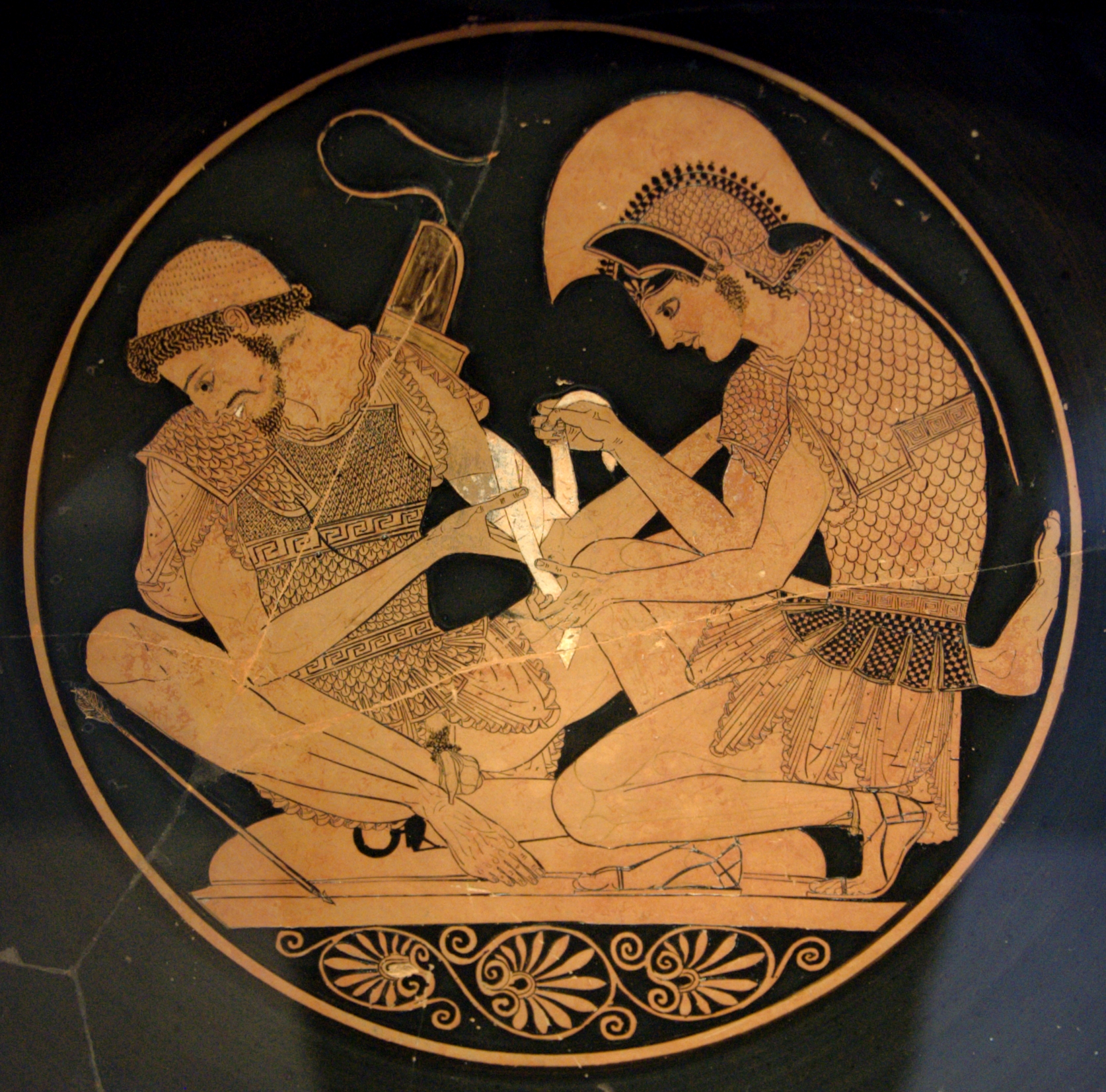
When Achilles hears of the death of Patroclus and falls into despair, it is Thetis, his divine mother, who rushes in with ointments and oils to prepare the body of his fallen friend. The anointing is not only funeral hygiene: it is respect, it is affection, it is the last act of care one can offer to someone loved.
The bond between Achilles and Patroclus has crossed the centuries as one of the great examples of total love in antiquity, made of absolute loyalty, rivalry and tenderness. In that story, oil appears as an element of intimacy: the other person’s body as a sacred place that deserves attention and care.
But it is in the Odyssey that the olive tree performs the most poetic gesture in all of classical literature. Odysseus’ bed was not built with wood that had been cut and carried in. Odysseus pruned an old olive trunk growing in the middle of his house, left the root in the ground, and carved the marriage bed out of the living wood. The whole house was built around that tree.
Odysseus’ bed is rooted in the earth. It cannot be moved, it cannot be taken away. It is loyalty built into the wood of an olive tree that is still breathing.
When Penelope, to test her husband back after twenty years, says she has moved the bed, Odysseus is outraged, certain that the bed cannot be moved. It is the detail that proves his identity more than any other sign.
Aphrodite, perfume and seduction
The ancients knew the softening and soothing properties of olive oil not through chemistry, but through experience gathered over centuries. And they made it a central element of cosmetics and seduction.
The scented essences of antiquity were almost all oil-based: myrrh, incense, roses, jasmine and lavender were macerated in oil to extract their aromatic compounds. What today we call perfume was called myron in classical Greece, and it always had oil as its carrier.
Aphrodite, goddess of beauty and love, never appeared without ointments. In the myths, her body, always anointed and perfumed, was an integral part of her power of seduction. Oil on the skin was not vanity: it was preparation, it was intention, it was the gesture by which one became worthy of pleasure.
There is a minor but fascinating myth about a ferryman named Phaon, old and rough, who one day carries Aphrodite, disguised as an old woman, across the water without asking for anything in return. Out of gratitude, the goddess gives him a small jar of ointment able to make whoever used it beautiful and desired. That ointment was made of olive oil. From that moment, the women of the whole island of Lesbos fell madly in love with him.
Rome, the wedding night and Aristotle
In Rome, oral tradition handed down to brides, through their mothers, the use of olive oil on the wedding night. Practical advice based on the soothing and lubricating properties of oil, known empirically even if not yet explained in scientific terms.
Aristotle, in the fourth century BC, had theorized that an oil-based ointment applied before intercourse could lower the chances of conception. A belief with no physiological basis, of course, but telling of how much the female body and the control of fertility were a subject of reflection even for the greatest minds of antiquity.
More credible, and confirmed over time, was the tradition of using oil as a medicinal ointment. Many centuries later, the Santo Spirito hospitals in Rome would use olive oil from Tuscia as a purifying treatment for the liver. What was empirical tradition had a real basis: the polyphenols in a quality extra virgin olive oil have anti-inflammatory properties documented by modern science. The ancients did not know oleocanthal, but they had sensed its effects.
Athena against Poseidon: how the city sacred to the olive tree was born
Of all the myths of the olive tree, the founding of Athens is the one that speaks most clearly about the value the Greeks gave to this plant.
The legend tells that Zeus decided to give the protection of the new city to the god who offered the most useful gift to humankind. Poseidon struck the rock with his trident and a horse sprang out: fast, powerful, able to win battles. Athena drove her spear into the ground and from that wound an olive tree was born.
Zeus chose Athena.
Why was a slow tree, which takes decades to bear fruit, judged more precious than a warhorse? Because the olive tree gave oil for cooking, for lighting, for anointing and healing. Because it was food, medicine, perfume and light all together. Because it outlived the centuries, carried the memory of whoever had planted it, and rooted families to the land.
The city was named Athens, and the olive tree became sacred to all Greeks.
A memory that has not been lost
Three thousand years later, on the tuff hills of Tuscia, grow olive trees rooted in the same civilization. The Caninese cultivar has been grown on those lands since Etruscan times: the same volcanic soil, the same wind from the Maremma, the same care at harvest.
The way the ancient Greeks understood oil, as a language of the body, an act of care, a form of conscious pleasure, is not so far from how an outstanding extra virgin olive oil lives on the table of someone who knows how to choose it. Not as a condiment, but as a gesture. Not as a fat, but as a sensory emotion.
That memory is still here.
From Etruscan Tuscia
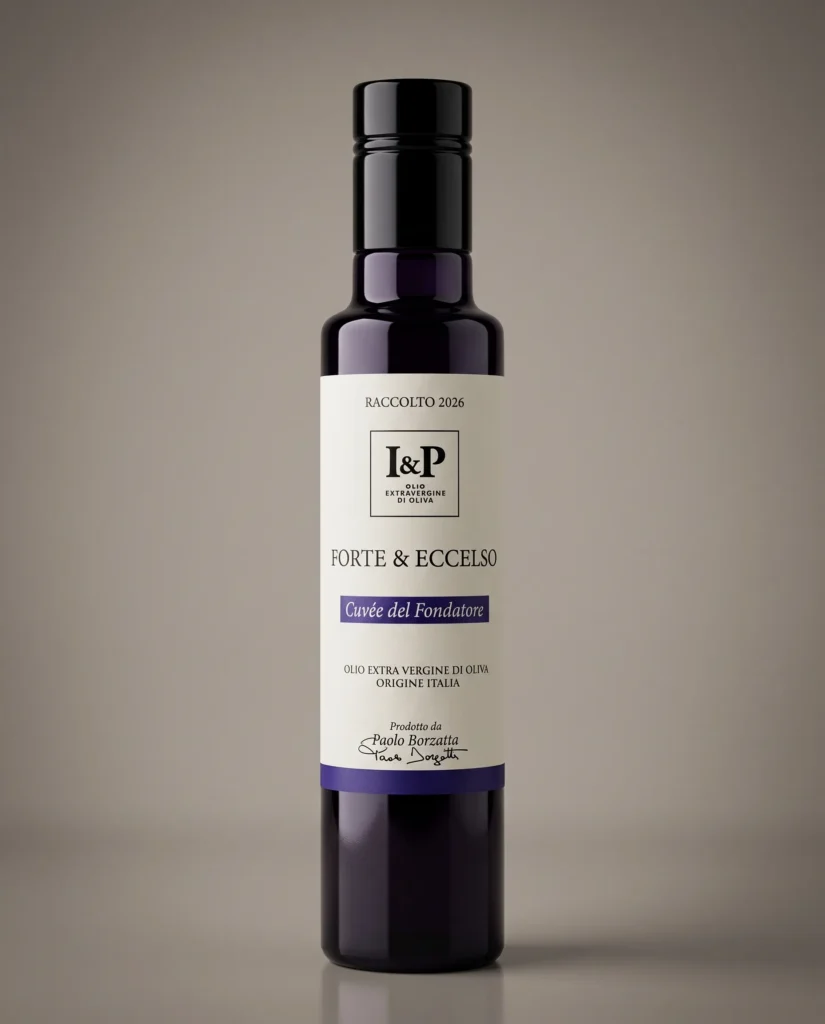
Forte & Eccelso, the Founder’s Cuvée
Paolo Borzatta’s blend. An oil that gives up nothing: intense fruitiness, firm bitterness, long persistence. Made for anyone who looks for more than nourishment in food: recognition. Just as the Greeks did.
Forte & Eccelso – Founder's Cuvèe
More than just an oil, it is a force of nature: imagine the energy of a green field where the vibrant power of pepper and wild chicory blends with the delicacy of flowers and pine nuts. A rare and magnetic balance, capable of captivating the senses with its complexity and leaving an indelible memory. It is pure excellence, created for those who seek an emotion on the plate that goes far beyond simple taste.

