
Caninese: history, sensory profile, and why it is unique in Italy
There are cultivars that everyone knows. The Ligurian Taggiasca, the Apulian Coratina, the Nocellara del Belice. Names that appear on labels, that are quoted on menus, and that the general public has learned to recognize.
And then there is the Caninese.
Cultivated for over three thousand years on the tuffaceous hills of the Viterbo area in Tuscia. Protagonist of a PDO (DOP) status obtained in 1998. Capable of producing oils with polyphenol concentrations that international competitors rarely approach. Chosen by almost all the oil mills in the area.
Yet, outside the province of Viterbo, almost no one knows what it is.
This is the story of the cultivar that is at the heart of every I&P oil. A story that begins in ancient Etruria, crosses centuries of princes and farmers, and reaches all the way to our single-cultivar Grand Crus. It is well worth knowing.
Three thousand years on the same soil: the Etruscan origins of the Caninese
It all begins around 900 BC, when the Etruscans of Vulci, the great city-state just a few kilometers from present-day Canino, planted their olive groves on the hills of Tuscia. This is not a romantic assumption: vessels for oil preservation and frescoes with harvesting scenes, featuring plants morphologically traceably back to the Caninese variety, have been found in the area's necropolises.
Then came the Romans, who perfected the processing techniques and turned Tuscia into one of the Empire's great olive-growing hubs. In the Middle Ages, these lands passed to the Farnese family: on February 28, 1468, right here, Alessandro Farnese—the future Pope Paul III—was born.
In the 19th century, the municipality of Canino became the fiefdom of Lucien Bonaparte, Napoleon's brother, who settled here with the title of Prince of Canino and Musignano. A name, Musignano, that today belongs to one of our single-cultivar Caninese Grand Crus, awarded with the highest honors by the leading Italian guides.
In 1996, with EC Regulation no. 1263/96, the Caninese obtained the Canino PDO (DOP) certification. A form of European recognition for something that local olive growers had known for three thousand years.
The terroir: why the tuff of Canino is irreproducible
To understand the Caninese, you have to understand the soil in which it grows.
Canino is situated in a geographically extraordinary position: 15 kilometers to the southwest is the Tyrrhenian Sea, and 15 kilometers to the northeast is Lake Bolsena, the largest volcanic lake in Italy. Within thirty kilometers, completely different microclimates and soil compositions coexist: coastal sand, clay, bedrock, tuff, and volcanic lapilli.
The tuffaceous soil deserves a special mention. Tuff is a porous, generally acidic volcanic rock that drains excess water perfectly while retaining minerals in a form easily absorbed by the roots. This combination generates a controlled hydric stress that drives the plant to produce more polyphenols as a self-defense mechanism: not a coincidence, but a measurable biological response.
To the climate are added rainy winters with temperatures that drop below zero, hot and dry summers, and the Maremma wind that keeps the olive groves aerated and naturally reduces the presence of pests.
The Caninese didn't just endure this environment: it co-evolved with it over millennia. And it became exactly what that territory demanded.
The plant: a paradox of strength and delicate refinement
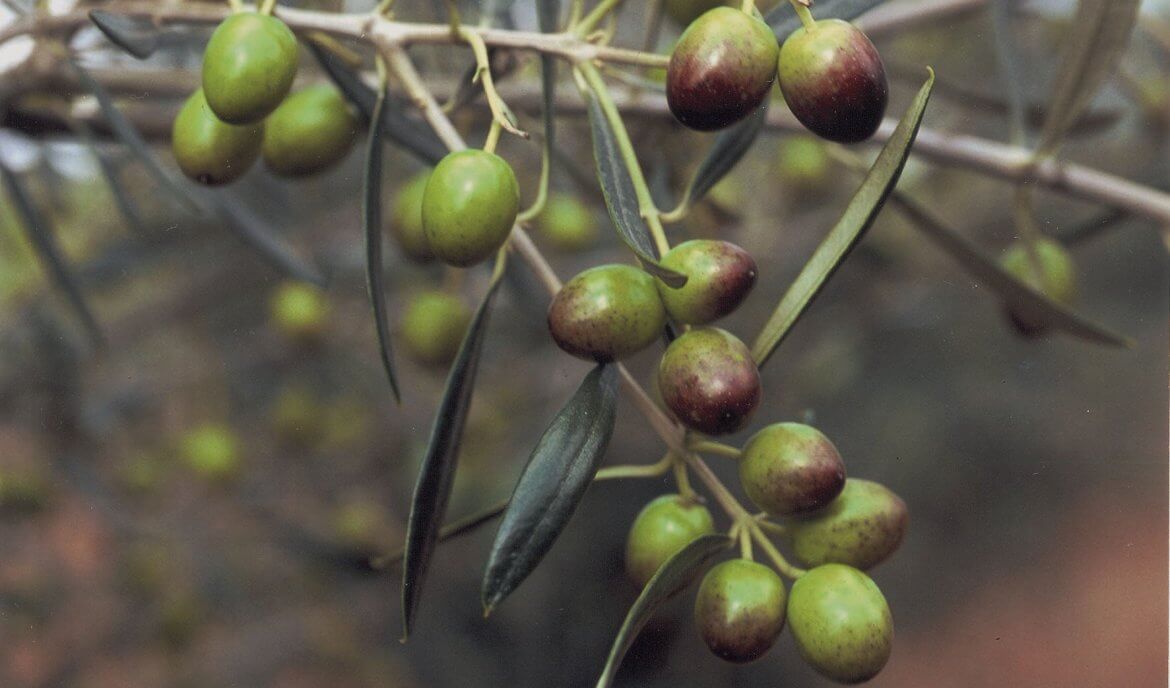
The Caninese is a tree that you can recognize from afar. An upright growth habit, a dense canopy, and elliptical-lanceolate leaves of an unmistakable gray-green. A formal, almost austere profile that anticipates the character of the oil it produces.
The fruit is small, between 1 and 1.5 grams. An apparent limitation: less weight per hectare, lower volumetric yield compared to large industrial cultivars. But the pit of the Caninese is also small and light, with a very favorable pit-to-pulp ratio. The actual oil yield stands between 17 and 20%, in line with the most productive cultivars overall. The small size of the fruit conceals a surprising yield.
Ripening is late and staggered: the fruits on the same tree do not change color all at once, but at different times over the course of weeks. Harvesting early, when the veraison is partial, means preserving an exceptional concentration of polyphenols. Waiting means losing complexity in exchange for a greater sweetness.
The Caninese is also highly resistant to the olive fruit fly, olive knot, and sooty mold—three of the main threats to Italian olive groves. This natural resilience makes it particularly well-suited for organic farming, ensuring that organoleptic quality is never compromised by phytosanitary treatments.
It has only one point of structural vulnerability: it is self-sterile. To produce fruit, it needs external pollinators, such as Leccino, Frantoio, and Pendolino, planted in a specific percentage within the olive groves. This biological constraint is also the reason why the traditional olive groves in the area have always featured a varietal biodiversity that is today a production and genetic heritage.
The sensory profile: what to expect in the glass
Every cultivar has a voice. That of the Caninese is immediate, recognizable, and difficult to mistake for anything else.
Nose
The olfactory profile of the Caninese is its most distinctive feature. The young oil, made from early-harvested olives, develops a green, wild, and rustic bouquet. The notes that almost always recur are:
- Raw artichoke: the signature of the Caninese, a bold and structured note
- Chicory and wild field lettuce: bitter herbaceous notes typical of the spontaneous wild herbs of the Maremma
- Cut grass: the classic green fruitiness, an indicator of freshness and a timely harvest
- Fresh almond: a sweet and rounded note that balances the herbaceous intensity
- Black pepper: emerges on the finish, contributing to the overall aromatic complexity
Mouth
The entry on the palate is clean and fruity. Then, the components that define its quality emerge: a bold but not aggressive bitterness, perceived on the sides of the tongue, which is the signature of oleuropein; a pungency that develops in the throat a few seconds after swallowing, proving the presence of oleocanthal; and a remarkable persistence, with a spicy aftertaste that recalls pepper and, in certain Crus, balsamic notes.
Caninese is not an oil for those seeking sweetness. It is an oil with character, one that takes a stand and does not disappear beneath a dish. And this is exactly why it pairs beautifully with the most structured preparations of Italian cuisine: legume soups, game, grilled meats, bitter vegetables, and aged cheeses.
Why the Caninese deserves more attention than it receives
The Caninese has never been an export cultivar. It was not selected to adapt to different climates, nor was it widespread in Australia or Argentina like the Frantoio. It stayed where it belongs, faithful to a specific territory, producing an oil that carries within itself the DNA of a civilization.
In a market dominated by standardized cultivars and anonymous blends, the Caninese represents the exact opposite: specificity, identity, and geographical uniqueness. No Spanish or Tunisian producer can make a Caninese oil, because the Caninese without the volcanic tuff of Canino, without the wind of the Tuscia region, and without three thousand years of adaptation to that precise territory, is no longer the same plant.
When you bring a monocultivar Caninese oil to the table, you are not just dressing a dish. You are bringing a territory to the table. A civilization. A history that begins before Rome.
How to choose a good Caninese oil
If you are considering a purchase, here are the criteria that truly matter.
Verify that it is a monocultivar. The word “Caninese” on the label can indicate either a 100% single-variety oil or a blend with variable percentages. Monocultivars offer the most authentic expression of the cultivar.
Look for the harvest campaign. The harvest date is the true indicator of freshness. The expiration date is calculated from bottling, which can happen months after the harvest. A Caninese from the 2025 campaign, purchased in the spring of 2026, is in optimal condition.
Check the declared parameters. A serious producer declares acidity and polyphenols. Below 300 mg/kg of polyphenols, you are paying for the name of the cultivar, not its actual quality.
The nose doesn't lie. If you smell raw artichoke, cut grass, and chicory, you are on the right track. A flat, neutral oil without character is not a quality Caninese, regardless of what the label says.
Store it well. Total darkness, stable temperature between 14 and 18 degrees Celsius, and cap sealed after every use. Consume within 12 months of the harvest to enjoy the aromatic and polyphenolic profile at its peak.
Want to discover which I&P Caninese Grand Cru best suits your taste and cooking habits? Try our sensory quiz: it guides you through your choice in just a few steps.

