
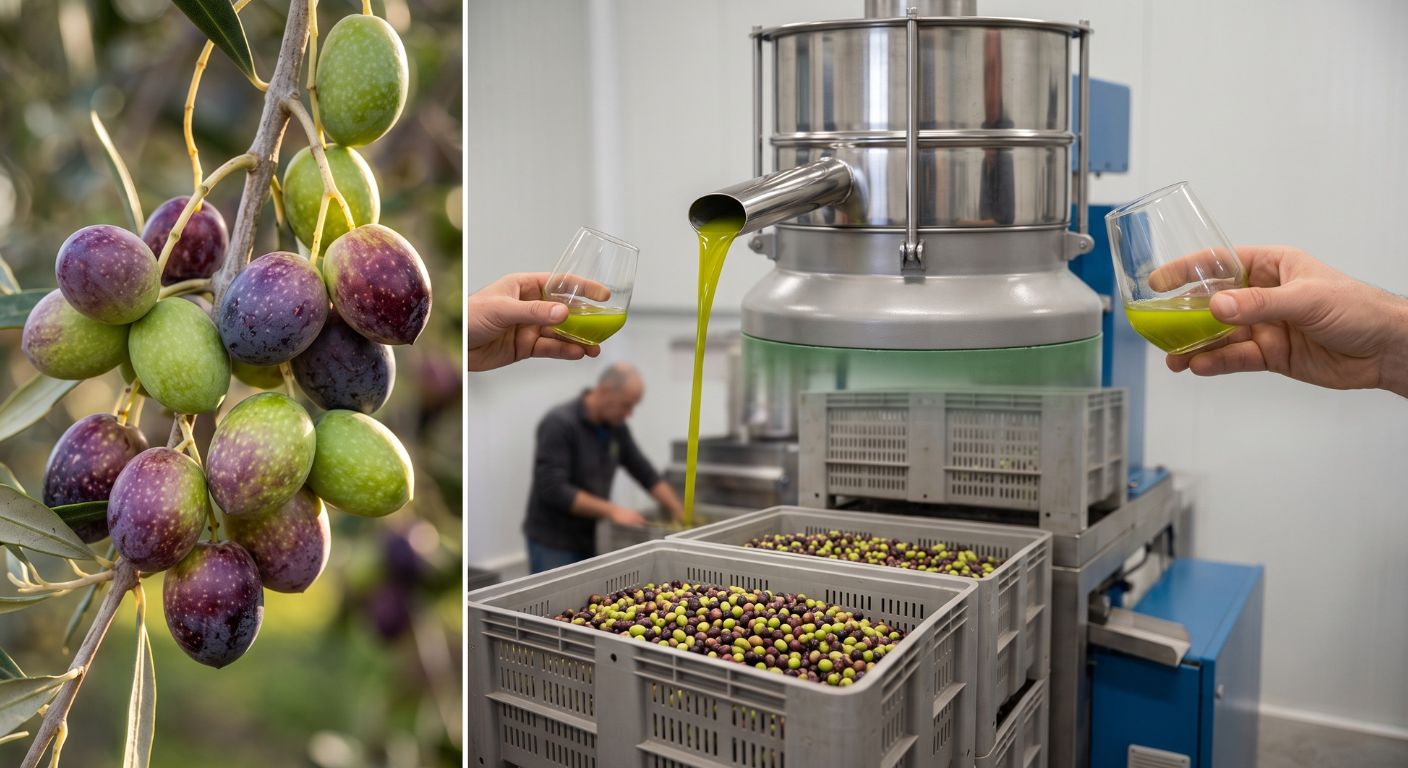
From field to bottle: how a quality extra virgin olive oil is obtained
Extra virgin olive oil is technically the simplest product in existence: juice of a fruit, mechanically extracted, without additives or chemical processes. It should be impossible to get it wrong.
Yet the market is full of mediocre oils sold as extra virgin. The difference between a 4-euro oil and a 20-euro Grand Cru does not lie in the packaging, nor in an abstract quality that is difficult to measure: it lies in a series of precise decisions, made at specific moments in the production process, which can be done well or poorly.
This guide walks through those decisions in the order they present themselves, from the moment you choose when to harvest to when the bottle is sealed. With a fundamental principle that is worth establishing right away: quality is not created at the oil mill. It is either preserved or destroyed. Quality is decided in the olive grove.
Step 01
The harvest: the most important decision of all
Of all the phases of the production process, harvesting is the one over which the producer has the most direct control, and where the consequences of choices are felt the most on the final product.
When to harvest
During ripening, olives undergo a change called veraison: the skin progressively turns from green to purple, then to black. This is not just a change in color: it is a profound biochemical transformation. As the olive matures, the oil inside it increases in volume but decreases in polyphenols. An unripe green olive has very little oil but is extremely rich in phenolic compounds. A black, fully ripe olive has the maximum volumetric yield but a significantly reduced concentration of polyphenols.
Those who want an evo with character, rich in oleocanthal and hydroxytyrosol, harvest early: incomplete veraison, with between 20% and 50% of the fruits having changed color. Those who want to maximize the yield in liters per hectare wait. These are two legitimate production philosophies, but they yield profoundly different oils.
The harvest date is not secondary information on the label. It is the signature of a producer's philosophy.
How to Harvest
Olives must never be harvested from the ground. A fruit that has fallen spontaneously is a fruit that has already begun its biological degradation: bruised, oxidized, and often attacked by the olive fruit fly. The acidity of an oil made from ground-harvested olives can be ten or twenty times higher than the legal limit for the extra virgin category. It is not extra virgin, regardless of how it is processed.
Harvesting methods from the tree fall into three main categories:
- Manual harvesting (Brucatura): the fruits are stripped by hand or using manual combs. This is the most respectful method for the integrity of the fruit, but it is extremely slow. It is still used for prized varieties on steep or rugged terrain.
- Pneumatic harvesters (vibrating combs): battery-powered or compressed-air tools that mimic the manual gesture at a higher speed. A good compromise between speed and quality: the olives are shaken without excessive trauma and collected in the nets below.
- Mechanical shakers: machines that clamp onto the trunk or branches, shaking the tree with force. Very high speed, ideal for large areas, but the olives suffer impacts that accelerate oxidation. This is acceptable only if the olives go to the oil mill within a few hours.
At I&P the harvest is done with pneumatic harvesting combs over nets on the ground. The olives are picked in the morning and taken to the mill within 4 hours in refrigerated vans. Choosing when to harvest is the most debated and closely watched production decision of the whole season.
Step 02
Transportation: the invisible phase that nobody talks about
Between the harvest and the oil mill, there is a phase that is rarely discussed but can compromise hours of well-done work: transportation.
Olives are living fruits, with active biological processes that continue after the harvest. Piled up in sacks or closed bins without aeration, they begin to ferment: the internal temperature rises, enzymatic activity increases, and acidity grows. The longer they remain in these conditions, the worse the oil will be.
The rules are simple but demanding. Olives must be transported in perforated plastic crates, not in sacks. In thin layers, not piled up. Protected from direct sunlight and heat. In refrigerated vans. And above all, they must arrive at the oil mill as soon as possible: ideally within 6 hours of harvest. A producer who harvests excellent olives and leaves them waiting for 48 hours in closed sacks or in holding yards has already compromised most of the work done in the olive grove.
Step 03
At the oil mill: cleaning, crushing, and the first technical choice
At the oil mill, the olives are first washed with cold water to remove soil, leaves, and residues. This is followed by crushing: the olives are crushed whole, including the pit, to obtain a homogeneous paste.
Stone mills or crusher?
Stone mills, the traditional stone grindstones, are slow and generate heat through friction. This heat can degrade polyphenols and promote oxidation if not carefully controlled. Modern hammer or disc crushers work quickly, generate less heat, and are better suited for temperature control. They are the preferred choice in high-quality production, also because the speed reduces the time the paste is exposed to the air.
Step 04
Malaxation: the most critical moment of the entire process
The paste obtained from crushing must be worked slowly in large tanks with rotating blades to encourage the small droplets of oil to aggregate into larger masses that are easier to separate. This is malaxation, and the temperature at which it takes place is the most critical variable of the entire production process.
Heat increases yield: the hotter it is, the more easily the oil separates. But heat degrades polyphenols, volatilizes aromatic compounds, and accelerates the oxidation of the paste. It is the classic compromise between quantity and quality.
| Temperature | Oil Yield | Polyphenols | Aromas | Label permitted |
|---|---|---|---|---|
| Under 27°C | Less | High | Preserved | Cold extracted |
| 27–35°C | Medium | Reducted | Some loss | Not permitted |
| Above 35°C | High | Minimum | Loss | Not permitted |
The phrase “cold extracted” on the label is not a slogan: it is a guarantee regulated by EC Reg. 1019/2002, which mandates a maximum temperature of 27°C during the entire process. Time matters too: beyond 40 minutes, the benefits on aggregation diminish, but exposure to air continues. Those aiming for high quality stay under 30 minutes at a controlled temperature.
I&P malaxation takes place below 27°C, with short times. All Grand Cru oils carry the wording “cold extracted” on the label. It is not a decorative detail: it is the result of a choice that gives up a few percentage points of yield and gains everything in sensory and polyphenol quality.
Step 05
Extraction: centrifuge, not press
The malaxed paste must be separated into its components: oil, vegetation water, and pomace. This is the extraction itself.
The decanter is a cylinder rotating at high speed that separates the components of the paste by density: the oil, being lighter, collects toward the outer edge, while water and solids are expelled separately. It is a continuous, rapid, hygienic, and easily controllable process.
Two phases or three phases?
The three-phase system adds water to the paste to facilitate separation, increasing the volume of wastewater. The two-phase system adds very little or no water: the yield is slightly lower, but the oil retains a higher polyphenolic concentration, and wastewater is reduced, benefiting environmental impact. There is also percolation or sinolea—extremely slow but capable of producing oils of superior sensory quality—used by very few niche producers.
Step 06
Filtration and storage: the oil is made, now it must be protected
Newly extracted oil still contains particles of pulp and suspended water residues. Many consumers aesthetically prefer cloudy, unfiltered oil. There is a technical problem, however: those particles accelerate oxidation and fermentation. Filtration does not impoverish the oil: it removes what would make it age prematurely.
After filtration, oil has three main nemeses: light, heat, and oxygen. The ideal tanks are made of food-grade stainless steel, kept at a constant temperature between 14 and 18°C, in a dark environment, with the upper portion maintained under an inert atmosphere—nitrogen or argon—to eliminate contact with air.
Step 07
The final tasting: the check that closes the loop
Before bottling, a high-quality extra virgin olive oil undergoes a sensory evaluation conducted by a panel of certified tasters. The panel test, established by EC Reg. 2568/91, is the only official method to organoleptically classify an oil under the "extra virgin" category: no chemical analysis alone is sufficient. The panel assesses the presence of positive attributes (fruity, bitter, pungent) and the absence of defects (rancid, fusty/muddy sediment, musty, winey/vinegary, metallic). An oil with any perceivable defect cannot be classified as extra virgin, regardless of its chemical parameters.
I&P Grand Cru oils are analyzed by Dr. Alfredo Marasciulo, former adjunct professor at the University of Bari and MIPAAF Panel Leader, and by the Chemiservice laboratory in Bari. Acidity, peroxides, total polyphenols and panel test results are documented for every harvest and available on request.
The journey in brief
| Step | Right Choice | Wrong Choice |
|---|---|---|
| Harvesting | Incomplete veraison, from the tree, within 24 hours | From the ground, ripe olives, long wait |
| Transportation | Aerated crates, thin layers, same day | Closed bags, piled up, days of waiting |
| Crushing | Fast, temperature-controlled | Slow, overheated paste |
| Malaxation | Under 27°C, max 30-40min | Over 30°C for high quantity |
| Extraction | Two-phase decanter, minimal water addition | Massive water addition, uncontrolled |
| Storage | Stainless steel, dark, 14–18°C, inert atmosphere | Exposure to light, heat, oxygen |
I&P - EXPERIENCES
Come and see for yourself
Reading about how olive oil is made is one thing. Seeing the olives arrive from the field, smelling the aroma of the freshly crushed paste, tasting the new oil straight from the decanter is quite another. I&P experiences take you to Canino, in ancient Etruria, during the harvest months.

