Counterfeit extra virgin olive oil: how to truly recognize it in 7 signs
Every year in Italy, tens of thousands of liters of oil sold as extra virgin that is not extra virgin are seized. The scandal is not only economic: it is a health issue. A seed oil colored with chlorophyll, a deodorized lampante oil, a blend of processing waste mixed at the last minute will not harm you like a poison, but it robs you of everything you thought you were buying: the polyphenols, the anti-inflammatory properties, the aromatic profile, the traceability.
The real problem is not spotting the bottles that are obviously suspicious. It is that the most sophisticated frauds easily pass a quick visual check. The right color, a dark glass bottle, an Italian label complete with “made in Italy”: and yet inside there is something completely different from what it promises.
This guide does not stop at the three tips you find everywhere. It starts from how the fraud works and gets to the concrete signs an attentive buyer can check before purchasing, with no lab equipment.
How the fraud works: the three most common types
Before knowing what to look for, it helps to understand what is out there on the market.
Seed oil with chlorophyll and beta-carotene. The most widespread and the easiest to produce. Refined seed oil, almost odorless and tasteless, with added chlorophyll (for the green color) and beta-carotene (for the yellow). Visually, the result looks like an extra virgin. It is not toxic, but it contains none of what makes olive oil precious.
Deacidified and deodorized lampante oil. Lampante oil is crude, inedible olive oil, too acidic and defective for food use, originally meant for lighting lamps. Through industrial refining, acidity and unpleasant odors are removed chemically. The result is a neutral oil that, mixed with a share of real extra virgin, takes on enough character to seem believable.
Refined olive pomace oil. Pomace is the solid residue left after processing the olives, the cake that remains after pressing. It still holds traces of fat, which are extracted with chemical solvents and then refined. Here too, blending it with extra virgin makes it sellable at a rock-bottom price.
All three of these products are sold legally in specific product categories, and they are not illegal as such. They become fraud when they are sold as “extra virgin olive oil”.
Sign 01
The price: the first warning threshold
Producing a liter of high-quality extra virgin olive oil has a structural minimum cost that cannot be squeezed beyond a certain point: manual or semi-mechanical harvesting of the olives, transport, milling within 6 hours, chemical and sensory analysis in the lab and panel test, bottling in dark glass, certifications, storage.
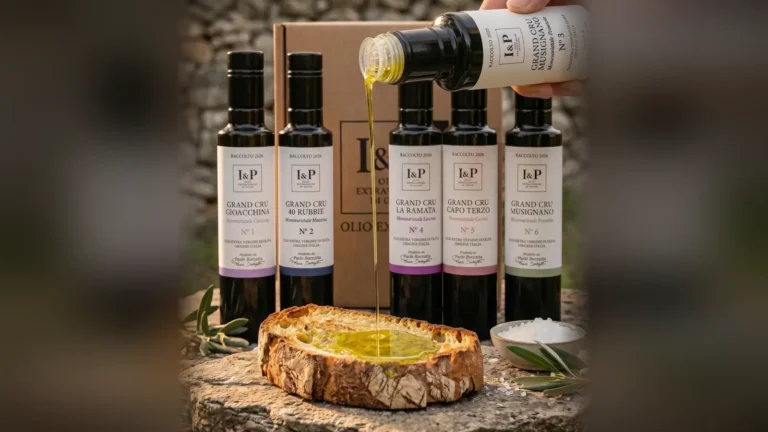
An average-quality extra virgin olive oil made from Italian olives cannot be sold today for less than 12-15 euros a liter without something in the production process being compromised. A single-cultivar Grand Cru from a certified olive grove sits between 20 and 40 euros a liter, depending on the harvest and the level of selection.
When you see an oil labeled “Italian extra virgin” at 4 euros a liter on offer at the supermarket, you are not finding a bargain. You are probably looking at EU oil of Spanish, Tunisian or Greek origin bottled in Italy, or a lower-grade blend passed off as extra virgin. A low price is not proof of fraud, but it is the first alarm bell that justifies further checks.
Sign 02
The harvest date: the most important piece of information that almost nobody reads
Extra virgin olive oil does not improve with time. From the harvest onwards it begins a slow decline: the polyphenols oxidize, the volatile aromas fade, the acidity can rise. An oil of excellent quality at harvest becomes mediocre after eighteen months, and frankly poor after two years.
The problem is that Italian law requires the label to show the best-before date, calculated from bottling, not from harvest. A dishonest producer can harvest the olives in October 2023, keep the oil in tanks for a year, bottle it in October 2024 and sell it until October 2026: the label will say “best before 10/2026”, which sounds reassuring, but the oil is three years old.
The harvest date, or “crop year”, is not required by law, but it is the bare minimum of transparency from a serious producer. If it is not on the label, ask for it. If the producer cannot or will not answer, you already have an answer about the kind of oil you are looking at.
Sign 03
The label: what to look for beyond the PDO mark
A PDO mark is a good sign, but not enough on its own. PDO guarantees the geographical origin and compliance with a production specification, but it does not automatically certify the excellence of every single batch. Some PDO oils are made with the minimum care needed to get certified, and some extraordinary oils are made outside any designation by small producers who never sought certification.
What really matters on the label:
- Origin of the olives. Not of the oil: of the olives. “Bottled in Italy” means nothing. Look for “Italian olives” or, better still, the region or town they come from.
- Declared cultivar. A producer who states the olive variety used (Caninese, Frantoio, Coratina, Taggiasca) takes precise responsibility for the sensory profile of the oil. It is a sign of trust.
- Extraction method. “First cold pressing” or “cold extracted” means the oil was processed below 27 degrees Celsius, preserving aromas and polyphenols.
- Declared acidity. Not mandatory, but serious producers show it. Below 0.3% means a high-quality oil. Above 0.6% (even within the legal limit of 0.8%) points to less than ideal olives or late processing.
- Total polyphenols. Not mandatory, but more and more common on artisan producers’ labels. Below 200 mg/kg the oil has little health value. Above 300 mg/kg you are in the territory of excellence.
A label that shows only “extra virgin olive oil”, a best-before date and a barcode is a label that does not want to be read carefully.
Sign 04
The fridge test: why it does not work
For years the advice has circulated to put the oil in the fridge for a few hours: if it solidifies or turns cloudy it would be authentic extra virgin, if it stays liquid it would be seed oil or a fake.
That is not how it works. All oils, seed oils included, tend to solidify or turn cloudy at low enough temperatures, because saturated and unsaturated fats behave differently in the cold. Extra virgin olive oil can solidify at around 4-6 degrees Celsius, but a high-oleic sunflower oil can do the same. Conversely, some extra virgin oils rich in unsaturated fatty acids stay fluid even at low temperatures.
The fridge test does not tell an authentic extra virgin apart from a counterfeit oil. Anyone who relies on it as their only check is giving themselves a false sense of security.
Sign 05
Color: a clue, not proof
Color is the sign the average shopper pays most attention to, and it is also the easiest to fake. Chlorophyll added to seed oils gives exactly that intense green many people associate with quality.
In reality, the color of an authentic extra virgin varies enormously depending on the cultivar, the harvest time and the extraction method. A Caninese harvested early in October is emerald green. The same oil bottled in January after a late harvest can be golden yellow. A Ligurian Taggiasca is typically golden. All outstanding extra virgin oils, all with different colors.
Use color as a first filter, not as a final verdict. An oil that is completely colorless or has an unusual tint (pinkish, deep orange) deserves suspicion. But a bright green guarantees nothing without the other checks.
Sign 06
Nose and palate: the two tests no chemistry can fully fake
A refined seed oil, however colored and flavored, cannot replicate the aroma profile of an authentic extra virgin. The aromatic complexity of olive oil, built on hundreds of volatile compounds that change with the cultivar, the land, the harvest time and the processing, is practically impossible to fake at the level of a careful tasting.
On the nose, a quality extra virgin must have a clear, recognizable scent: green fruitiness (cut grass, artichoke, fresh almond) or ripe fruitiness (tomato, nuts, flowers). It must have character. An oil that smells of nothing, that tastes of neutral fat or plastic, that smells rancid or musty is not authentic extra virgin, or it is a badly deteriorated one.
On the palate, the two most important signs are bitterness and pungency. Untrained palates perceive both as defects, but they are actually proof that polyphenols are present. Bitterness is the signature of oleuropein, felt on the sides of the tongue. Pungency, that “burning” feeling in the throat a few seconds after swallowing, is the signature of oleocanthal, the compound with anti-inflammatory properties comparable to ibuprofen.
An oil that does not catch in the throat is not necessarily bad, but it is almost certainly poor in polyphenols. Authentic extra virgin or not, it is not worth much nutritionally.
A sweet, flat oil with no character may be authentic but low in quality, or it may be a neutral oil that has been boosted. Either way, it is probably not what you are looking for.
Sign 07
Glass and light: the container tells you about the producer
Polyphenols break down quickly in the presence of light. A producer who has invested in a quality oil always bottles it in dark glass (deep green or amber) or in a fully opaque material. A clear bottle exposed to the light of a supermarket shelf speeds up the decline of everything that makes that oil precious.
Plastic bottles, allowed by law, are the sign of an oil designed for mass retail, not for quality. Plastic polymers can release compounds that alter the oil’s aromatic profile over time, especially if it is stored somewhere warm.
A tinplate steel can is a good choice: it fully protects from light and does not interact with the oil. It is what large producers use for the bigger formats meant for restaurants. The latest solution is the Bag in Box. No oxygen at all, and a handy tap to pour the oil: convenience and quality.
Recap: the 7 signs at a glance
The difference that cannot be faked
There is a way out of the uncertainty altogether: buy from producers who publish certified analytical data for their oils. Acidity, peroxide value, total polyphenols, panel test results: these numbers cannot be invented or faked, because they are signed by accredited laboratories and official panel leaders.
A producer who puts those numbers on the label or on their website has nothing to hide. It is the highest form of transparency in a sector that urgently needs it.
Find out which I&P extra virgin is right for you
Every I&P Grand Cru has certified analytical data: acidity, polyphenols, harvest date. Nothing to hide, everything to tell. If you do not know where to start, our sensory quiz guides you in a few steps to the right oil for your palate and your cooking habits.
Take the sensory quiz