Benefits of extra virgin olive oil: what science really says
The Mediterranean diet is the most studied dietary pattern in the world. Decades of epidemiological research, randomized clinical trials, and meta-analyses: no other dietary system has accumulated a comparable scientific body of evidence supporting its health effects. And at the center of that diet, as the primary source of fat, there it is.
Extra virgin olive oil did not become a symbol of health through tradition or marketing. It became one because the data support it. But with one condition that changes everything: not all extra virgin olive oils are the same nutritionally, and the difference between an industrial EVOO and a single-cultivar Grand Cru is not only sensory. It is biochemical.
Composition: why extra virgin olive oil is different from all other fats
Extra virgin olive oil is composed of about 70-80% oleic acid, an omega-9 monounsaturated fatty acid. This characteristic clearly distinguishes it from animal saturated fats (butter, lard) and from vegetable oils rich in polyunsaturated fatty acids (sunflower, corn, soy).
Oleic acid is heat-stable, resistant to oxidation, and does not raise LDL cholesterol. On the contrary, numerous studies have shown a correlation between a high intake of oleic acid and the reduction of oxidized LDL cholesterol, which is the form that is actually dangerous for the arteries.
But the fatty acid composition is only the first level. What truly distinguishes a high-quality extra virgin olive oil is its minor fraction: vitamins, squalene, and, above all, polyphenols.
Polyphenols: the component that sets an excellent EVOO apart from the rest
Polyphenols are phenolic compounds naturally found in olives, serving an antioxidant function for the plant itself. High-quality oil, extracted from healthy olives harvested at the optimal time, contains significant concentrations of them. In mass-produced, low-quality, or simply old extra virgin olive oil, they are almost non-existent.
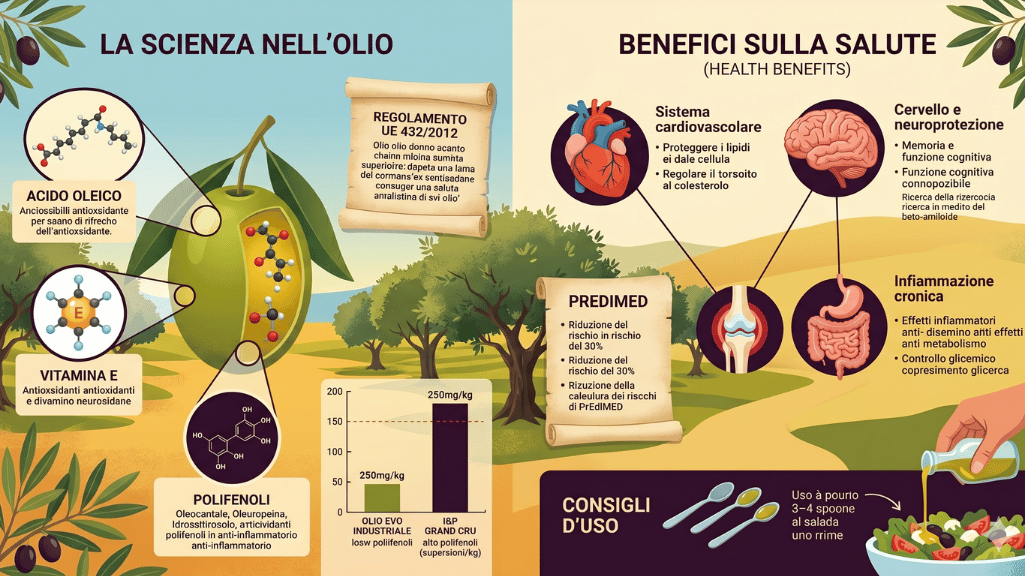
This distinction is so significant that the European Union has approved an official health claim under EU Regulation 432/2012. This allows the following statement to be used on oils containing at least 250 mg/kg of polyphenols (expressed as hydroxytyrosol and its derivatives):
“Olive oil polyphenols contribute to the protection of blood lipids from oxidative stress.”
This is not an advertising slogan: it is a legally regulated health claim based on scientific reviews by EFSA, and it can only be placed on the label by producers who meet that threshold. A mass-produced oil priced at 4 euros a liter almost certainly falls short
I&P Grand Cru oils range between 336 and 749 mg/kg of certified polyphenols: well above the threshold for the EFSA claim, and significantly above the market average.
Active molecules: what they actually do
POLYPHENOL
Oleocanthal
Responsible for the burning sensation in the throat. A study published in Nature in 2005 (Beauchamp et al.) demonstrated that it acts as a COX-1 and COX-2 inhibitor, the exact same mechanism as ibuprofen. At a daily dose of 50ml of EVOO, the anti-inflammatory effect is comparable to about 10% of the standard dose of the painkiller.
POLYPHENOL
Oleuropein
A powerful antioxidant, found primarily in unripe olives and early-harvest oils. In vitro and in vivo studies link it to the protection of vascular endothelial cells, lower blood pressure, and antibacterial effects. It degrades rapidly as the oil ages.
POLYPHENOL
Hydroxytyrosol
The polyphenolic compound explicitly cited in the EFSA claim. One of the most powerful antioxidants of natural origin, with the ability to neutralize free radicals and protect LDL from oxidation. Present in high concentrations in polyphenol-rich oils, almost non-existent in mass-produced ones.
Vitamin + Terpenoid
Vit. E & Squalene
Vitamin E (tocopherols) is a fat-soluble antioxidant that protects cell membranes. Squalene, a precursor to cholesterol, is found in olive oil in much higher concentrations than in any other vegetable oil. Studies suggest a protective role for the skin and an effect on cholesterol regulation.
What the most prominent studies show
The PREDIMED Study
In 2013, the New England Journal of Medicine published the results of the PREDIMED trial (Prevención con Dieta Mediterránea), one of the largest nutritional intervention studies ever conducted. It involved over 7,000 participants at high cardiovascular risk and followed them for an average of 4.8 years.
The group following a Mediterranean diet enriched with extra virgin olive oil (about 4 tablespoons per day) showed a 30% reduction in the risk of major cardiovascular events (heart attack, stroke, cardiovascular death) compared to the low-fat diet control group. The study was confirmed by subsequent analyses and updates, and remains the primary reference for the cardiovascular effects of the Mediterranean diet.
Estruch R. et al., New England Journal of Medicine, 2013. Updated 2018. Randomized multicenter trial, n=7,447. 30% reduction in the risk of major cardiovascular events in the group following a Mediterranean diet supplemented with EVOO. No significant benefit in the low-fat group.
Polyphenols, longevity, and Italian research
Italian research on olive oil polyphenols has produced significant contributions to the fields of longevity and the prevention of degenerative diseases. Studies conducted at Sapienza University of Rome, involving Prof. Francesco Violi—a leading cardiologist and researcher on the Mediterranean diet—have investigated the role of hydroxytyrosol in reducing oxidative stress and providing cardiovascular protection.
The common thread of this research is consistent: at high enough polyphenol concentrations, extra virgin olive oil is not simply a healthy fat. It is a functional food with biologically measurable effects on reducing chronic inflammation, protecting LDL from oxidation and on glucose metabolism.
Blood sugar and insulin response
Studies on the effect of high-quality extra virgin olive oil on postprandial blood sugar response have shown that consuming polyphenol-rich EVOO before or during a carbohydrate-heavy meal reduces the glycemic spike compared to using refined oils. The proposed mechanism involves the interaction between polyphenols and the enzymes responsible for starch digestion, effectively slowing down glucose absorption.
Heart, inflammation, brain: the three areas with the strongest evidence
Cardiovascular system. This is the most well-established area of research. Oleic acid reduces oxidized LDL. Polyphenols protect the vascular endothelium. Oleocanthal inhibits platelet aggregation. The combined effect of these mechanisms through regular consumption of high-quality EVOO is a measurable reduction in cardiovascular risk, confirmed by PREDIMED and dozens of subsequent studies.
Chronic inflammation. Low-grade chronic inflammation is currently considered a cross-cutting risk factor for the most widespread degenerative diseases: type 2 diabetes, cardiovascular diseases, certain forms of cancer, and neurodegenerative conditions. Oleocanthal and oleuropein have demonstrated documented anti-inflammatory effects. High-quality EVOO, consumed regularly, helps modulate this process.
Brain and neuroprotection. This is the most recent and still evolving area of research. Studies on animal models and epidemiological observations in humans suggest a role for oleocanthal in reducing the accumulation of beta-amyloid proteins, which are associated with Alzheimer's disease. Research conducted at Temple University in Philadelphia has shown that a diet rich in EVOO preserves memory and cognitive function compared to control diets. The data are preliminary but consistent with the already documented anti-inflammatory mechanism.
The fundamental discriminator: not all extra virgin olive oil is created equal
This is the part that generic olive oil communicators almost always omit, yet it radically changes the practical value of everything stated above.
The benefits described in this article refer to a high-quality extra virgin olive oil with a significant polyphenol content. A 4-euro-per-liter EVOO purchased at the supermarket, sourced from olives of multiple EU countries, extracted using maximum volumetric yield techniques, and stored in inadequate conditions, can have polyphenol concentrations below 50 mg/kg. The EFSA threshold for the oxidative protection health claim is 250 mg/kg.
In other words: a low-quality industrial EVOO is not a functional food. It is simply an edible fat, with the basic properties of oleic acid but without the added value of polyphenols.
Certified by Dr. Alfredo Marasciulo, Chemiservice laboratory in Bari.
How much to use and how
The traditional Mediterranean diet guidelines indicate an optimal consumption of 3-4 tablespoons per day (40-60 ml) of extra virgin olive oil, distributed across meals. This is an amount that many Italians already reach naturally while cooking, but it must be understood as high-quality oil, not just any EVOO.
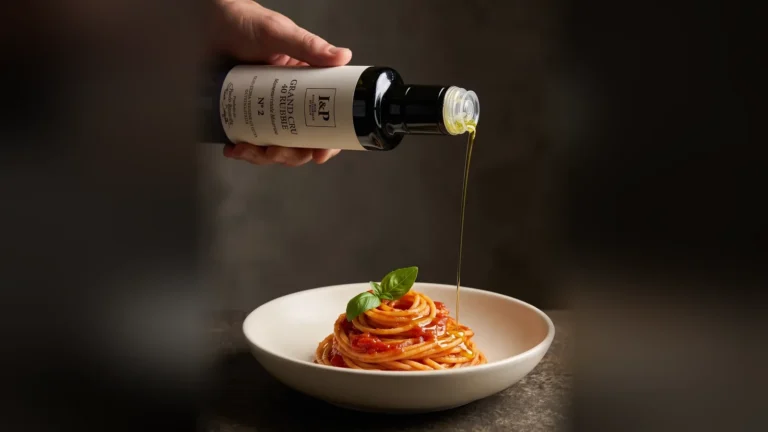
Using it raw best preserves the polyphenols, which partially degrade with heat. This does not mean that cooking with EVOO is useless: oleic acid and many polyphenols resist ordinary home cooking temperatures well. But to maximize polyphenol intake, a drizzle of fresh raw oil right before serving is always the most effective choice.
Storage significantly affects quality: light, heat, and oxygen degrade polyphenols rapidly. A high-quality EVOO poorly stored for six months can lose most of its polyphenolic value. Dark glass, a stable temperature, and a tightly closed cap: these are not details.
Grand Cru with certified polyphenols
above the EFSA threshold
The polyphenol values of I&P Grand Crus are not estimates: they are certified analytical data from an accredited laboratory, published and verifiable. If you choose extra virgin olive oil also for its health benefits, it makes sense to choose an oil whose numbers you actually know.