Extra Virgin Olive Oil in Children's Nutrition: From Weaning to Snack Time
There is a gesture that many of us remember from childhood: a slice of bread, a drizzle of olive oil, perhaps a pinch of salt. Nothing elaborate. Yet, decades later, that flavor returns to mind with a precision that speaks volumes about the quality of what we were fed.
Today, parents are faced with shelves full of formulated products, fortified snacks, and foods "specifically designed for children." In this scenario, extra virgin olive oil risks seeming like an outdated, almost mundane choice. It is not.
We asked this directly to someone who works every day with nutrition as a tool for health. Dr. Angela Zoccali, a nutritionist, explained to us why quality extra virgin olive oil is one of the most precious foods we can bring to the table right from the very first months of life.
Dr. Zoccali, what are the primary nutritional benefits of extra virgin olive oil?
It is a true goldmine, still underrated, of about 300 bioactive compounds. From my perspective, there are three most significant nutritional benefits.
First and foremost, oleic acid and polyphenols such as oleocanthal possess antioxidant and anti-inflammatory properties documented by international scientific research, with positive effects on long-term cellular protection.
Secondly, hydroxytyrosol, one of the main polyphenols in quality extra virgin olive oil, contributes to regulating blood pressure and reducing oxidized LDL cholesterol—the one that is actually dangerous for the arteries.
Thirdly, an aspect that is often overlooked: vitamin E and monounsaturated fatty acids support hormonal health and play a role in fertility. For this reason, extra virgin olive oil is one of the most complete foods nature has to offer, provided we choose genuine quality.
For children's nutrition, is the consumption of extra virgin olive oil recommended right from the very first months?
Absolutely, and I would say it is even highly recommended. As parents, we want the best for our children, and the best is to build, right from the start, dietary habits that support growth and health over time. Extra virgin olive oil is one of these habits. We were born in a country that produces a great quantity of it and of excellent quality: let's use it just as our parents and grandparents did, with the awareness that today science widely confirms its value.
At what age can it be introduced, and how?
Right from weaning. Adding a teaspoon of raw extra virgin olive oil to their first baby foods helps the infant assimilate fat-soluble vitamins—vitamins A, D, E, and K—which require the presence of fats to be absorbed. It also provides antioxidants and phenolic compounds that are not present in other vegetable oils extracted from seeds, because the olive is a fruit, possessing a biochemical complexity that seeds simply cannot replicate.
An important aspect concerns the lipid profile. Extra virgin olive oil has a favorable fatty acid composition, with a prevalence of oleic acid—a monounsaturated fat whose structure is closer to the lipid profile of breast milk than cow's milk is. This makes it particularly suitable during weaning, in the period preceding the regular introduction of fish, another essential source of fats crucial for neurological and visual development.
There is a less known but equally valid use: in infants, extra virgin olive oil applied topically helps with cradle cap and diaper rash. It contains squalene, a substance very similar to skin sebum, which has an emollient and soothing effect. Grandmothers used to apply "oil whipped in water" for redness: it was an empirical practice with a real scientific basis.
And for older children, how do you recommend using it?
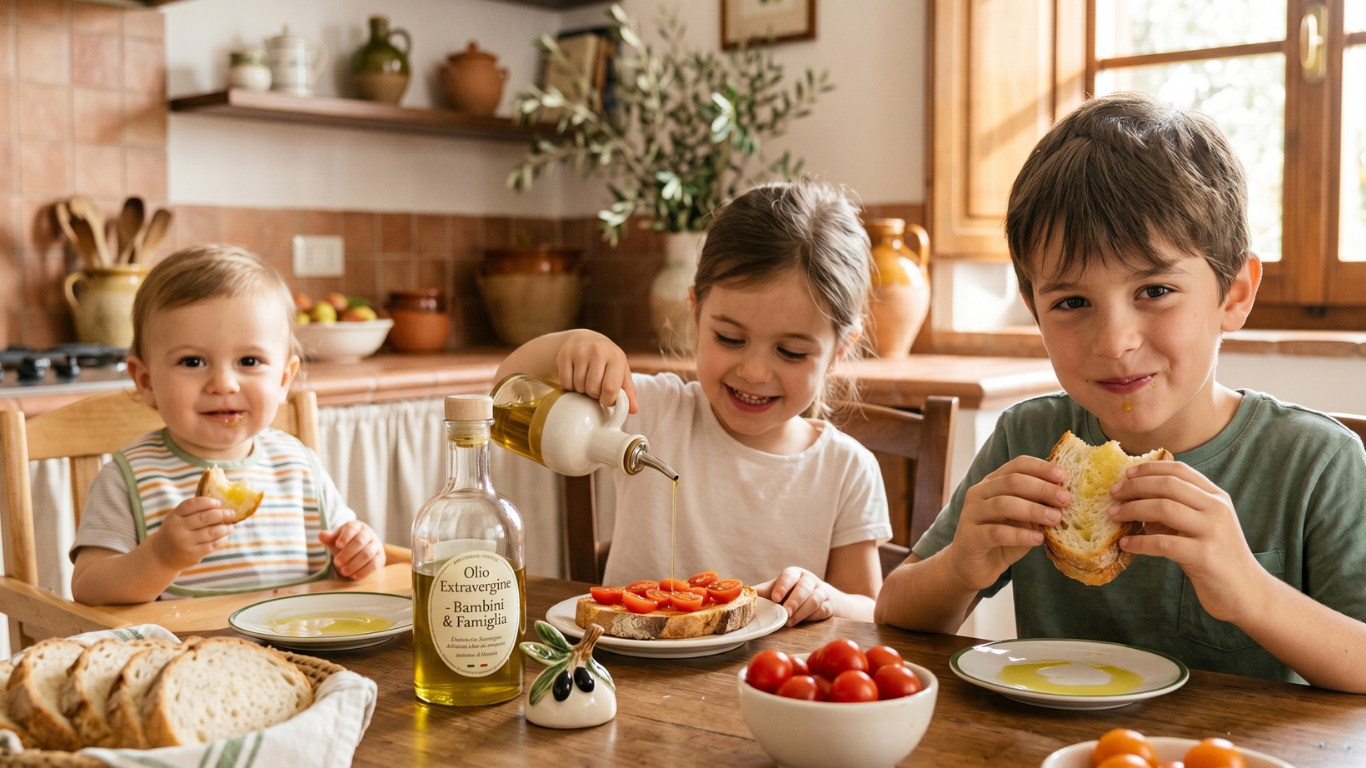
Here, I like to rediscover a tradition we are losing: the snack of bread and olive oil. It is not nostalgia; it is a balanced meal in the most concrete sense of the word. Complex carbohydrates from the bread, quality fats from the extra virgin olive oil, and if we add a pinch of sea salt and perhaps some raw vegetables on the side, we have a healthy alternative to any packaged snack. More generally, getting children used to eating raw or steamed vegetables with a drizzle of olive oil builds a taste habit that will stay with them for a lifetime. Extra virgin olive oil also has a regulating effect on intestinal and liver activity: on an empty stomach, a small amount can be helpful in cases of constipation, thanks to its mild laxative action.
Kids often want French fries. What should we do?
Without overdoing it, we can satisfy their cravings without feeling guilty. And it is even better if we fry them ourselves at home using a good extra virgin olive oil. Contrary to what many think, high-quality extra virgin olive oil resists well at domestic frying temperatures, which hover around 170-180°C: an oil with low acidity and a high polyphenol content is heat-stable, does not produce toxic compounds, and forms a thinner crust around the food compared to seed oils, often making it more digestible. Frying with extra virgin olive oil is a well-established Italian tradition in many regions. It is not a fallback; it is the best choice available, for children and adults alike.
One final question: how much extra virgin olive oil can be consumed daily, including by parents?
In the weight loss diets and personalized nutrition plans that I develop, I allow extra virgin olive oil to be used every day, raw, without measuring it out with a dropper. It is a healthy, satiating fat with a nutritional profile that has no equivalent. Those who eat well, with quality and balanced foods, have no reason to ration extra virgin olive oil as if it were a luxury to be limited. It is exactly the opposite: it is one of the foods worth investing in, in terms of quality even before quantity.
- Extra virgin olive oil is introduced starting from weaning, added raw to the first baby food to promote the absorption of fat-soluble vitamins A, D, E, and K.
- Its lipid profile, rich in oleic acid, is close to the composition of breast milk and is particularly suitable during the growth stages that precede the regular introduction of fish.
- For external use, the squalene in extra virgin olive oil helps in cases of cradle cap and diaper rash in infants.
- A snack with bread and olive oil is a balanced meal: complex carbohydrates, quality fats, and no additives.
- Frying with high-quality extra virgin olive oil is safe and often more digestible than seed oils, thanks to the thermal stability of oleic acid.
- The consumption of extra virgin olive oil should not be rationed: a healthy adult can use it freely every day, even in weight loss diets.
Bread and olive oil is not a fallback snack. It is the oldest and wisest meal known to Italian cuisine.
A genuinely high-quality extra virgin olive oil,
on your table every day
Dr. Zoccali says not to ration it. We would add: choosing it wisely makes all the difference. I&P Grand Crus feature certified polyphenols above 300 mg/kg, a declared harvest date, and originate from a single olive grove. For those who want to know exactly what they are bringing to the table, especially when it comes to their own children.